Chechu Alava
"Chechu Alava was born in Piedras Blancas, Asturias, 1973. She received her Bachelor of Fine Arts from the school of Salamanca in 1995 and won the Erasmus scholarship to study at the Rietveld Academy in Amsterdam. After her stay in London in 1997 she began an artistic journal (of sorts) - made up of drawings, collages and photographs.
Her personal style is focused on the eternal representation of what surrounds us and the search of identity through painting. The trail begins in her subconscious and is completed with visiting museums, the reinterpretation of genres such as portrait or landscape, literature of the 19th century and cinema. Her final work is shown through the representation of reality and the passionate love of pictorial language." - http://www.spainculturenewyork.org/whats-on/calendar/event/chechu-alavas-romanov-series-at-fictionnon-fiction-collection/

From the Romanov Series by Alava

"Au Revoir, Mr Freud"
What really attracts me to Alava's work is her style of painting. She seems to create these portraits with a modest finish, by using muted colours they make the paintings look as though they have some sort of material over them, and keep the details of the figures hidden from the viewer.
This modest and textured technique is something I would really like to feature with my own work. Instead of exploring with just paint however, I think I will get more interesting outcomes if I use a broad range of materials.
"Jane Bustin explores the processes and subject matter of contemporary painting through a minimal concept lead practice that combines tradtional technuqies with a wide variety of contemporary and historic materials and supports, including aluminium, wood, copper, silk, paper, latex, gesso, ceramics and ready-made objects.
Bustin's paintings are initiated following intense periods of research or collaboration... The work explores the metaphysical potential for painting to 'make visual' philosophical concepts found primarily in literature, as well as music, science, dance and theology... While minimal in style the works are intensely personal in subject..." - http://www.copperfieldgallery.com/jane-bustin.html

This modest and textured technique is something I would really like to feature with my own work. Instead of exploring with just paint however, I think I will get more interesting outcomes if I use a broad range of materials.
Jane Bustin
Bustin's paintings are initiated following intense periods of research or collaboration... The work explores the metaphysical potential for painting to 'make visual' philosophical concepts found primarily in literature, as well as music, science, dance and theology... While minimal in style the works are intensely personal in subject..." - http://www.copperfieldgallery.com/jane-bustin.html
"Tablet 4" Made using acrylic, oil, paper and latex, by Bustin




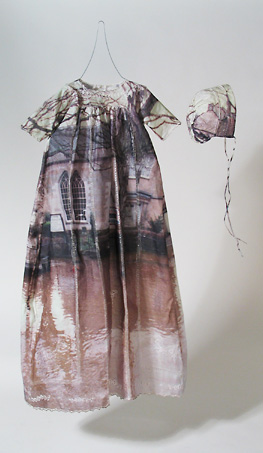
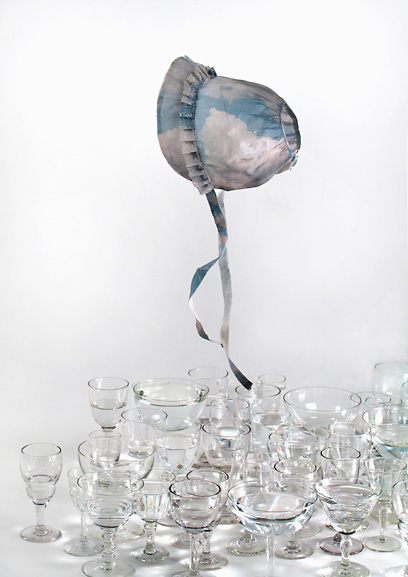


'Christina' made with nylon, chiffon and oil on wood
Bustin uses very muted and neutral tones within her work, which gives it an aged look. I like that Bustin uses ready-made objects as well as her own; I have also been exploring working in this style, by using the the ancestors portraits and objects around the home.
Sarah Charlesworth
"Sarah Charlesworth was born in 1947 in East Orange, New Jersey, and passed away in 2013 in Falls Village in Connecticut. She received a BA from Barnard College in 1969 and lived and worked in New York City and Falls Village. She has been the subject of solo exhibitions at a number of institutions, including a retrospective organized by SITE Santa Fe (1997) which travelled across the US.
Her Influential body of work deconstructed the conventions of photography and gave emphasis to the medium's importance in mediating our perception of the world. Charlesworth's practice bridged the incisiveness of 1970's Conceptual art and the illuminating image-play of the later identified "Pictures Generation"." - http://www.newmuseum.org/exhibitions/view/sarah-charlesworth

"Still life with Camera" Cibachrome prints and a mahogany frame, 1995
"Camera Work" 2009
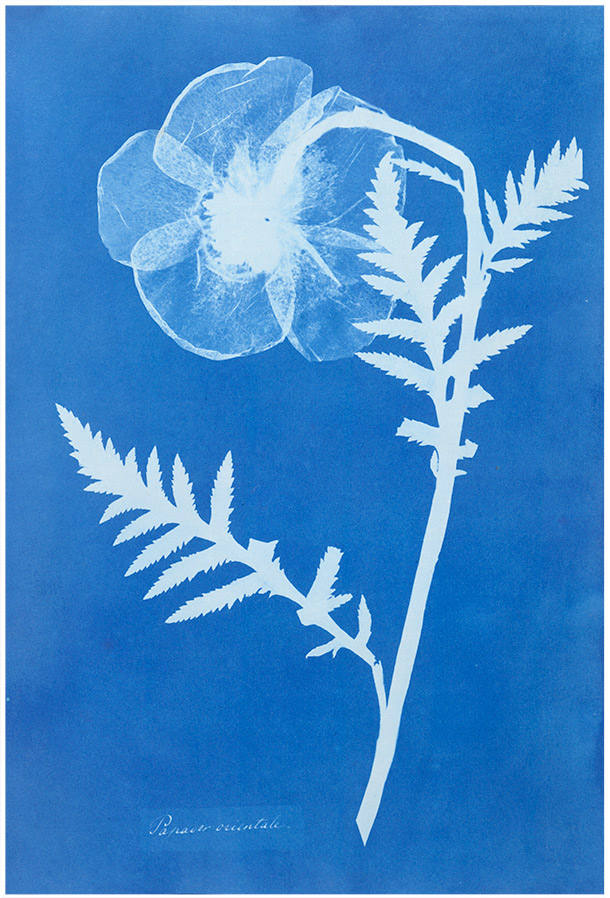
I particularly love Charlesworth's "Still life with Camera" piece, because of the mahogany that surrounds and compliments the objects that have been photographed. Looking at her "Camera Work" piece reminds me of Anna Atkins' cyanotypes because of the positive/negative approach on one object.
Atkins (1799-1871)
I would like to create some sort of negatives from my ancestors' portraits, or even objects I have inherited that belonged to them.
Laurent Chehere
"French photographer Laurent Chehere is known for his commercial work for clients such as Audi and Nike,but after a change of interest he left advertising and travelled the world with stops throughout China, Argentina, Columbia, and Boliva. From his numerous photographs along the way was born the Flying House Series, a collection of fantastical buildings, homes, tents and trailers removed from their backgrounds and suspended in the sky as if permanently airborne." - http://www.thisiscolossal.com/2013/01/flying-houses-by-laurent-chehere/
What intrigues me about Chehere's work is how he creates a character for each of these buildings he has floating in the sky. The colours used in each can alter someone's interpretation on them quite easily. The circus tent for example has a romantic sky behind, with small elements of a purple/pink that blends with the overall brightness of the lighting in the image.
Freya Douglas- Morris
"Freya Douglas-Morris is an extraordinary fine artist, her work resonates with memories conjured by her travels throughout the world. As a painter what interests Freya is the emotional response that sublime landscape can produce, which is loaded with personal interpretation. Freya walks the land, documenting details, mentally and physically (sketches and photographs) records the natural world... Back in the studio she 'reforms and interpret these, into layered images using a mixture of combined memories, which form new, but on the whole recognisable scenes; landscapes into which the viewer can relate but not entirely place.
As she states: 'Its is the vastness of space, the sense of areas hidden and forgotten, to which I am drawn. The decaying beauty and contrast between the strength and fragility that these spaces provide. I often include an object, or suggestion of a past human presence, into which a narrative is hinted, but not entirely understood.'" - http://www.saatchigallery.com/artists/freya_douglas_articles.htm

"The Illusionist" by Douglas- Morris, oil on canvas

"Furling" By Douglas-Morris, oil on linen
Although I love Douglas-Morris' paintings, I am most drawn to her as an artist because of what her work is about. The use of 'personal interpretation' in her work makes it exciting to view. She makes herself part of this painting, and this idea of her layering 'images using combined memories' from her travels, engaging the viewer into interpreting the landscape painted even more so.
Shelly Goldsmith
"Goldsmith has exhibited at major galleries and museums in Britain, Europe, the USA and Japan. Her work is in many notable public collections including: the V&A, Nottingham Castle museum, the Crafts Council and the Whitworth Museum. During 1991 to 2006, she was Head of BA (Hons) and MA Textile Art at Winchester School of Art, University of Southampton." - http://www.vam.ac.uk/content/articles/i/interview-shelly-goldsmith-textiles-artist/
Goldsmith brings a nostalgic, intricate and fragile approach to textiles. The lack of narrative included with her work means the viewer is able to create their own story behind these pieces of clothing and the images printed onto them. For example Goldsmith's glove piece; is the woman on the fingers the owner of the glove? Maybe she was a bride to be?
Ewa Juszkiewicz
"She holds a painting degree from the Academy of Fine Arts in Krakow. She is a member of the VJ collective AAA Tanie Wizualki.
As an artist, she chiefly deals with the portraits of women. She creates paintings that refer to well-known early modern works, especially Flemish ones. The only difference lies in the way of presenting the portrayed persons' faces. Juszkiewicz imaginatively distorts these faces or substitutes them with large polypores, the bodies of insects, bouquets of flowers, tribal masks, or draped fabrics. Surrealistic, disturbing paintings loosely based on the originals are created as a result. These works by Juszkiewicz sometimes are copies with a single, subtle alteration."- http://culture.pl/en/artist/ewa-juszkiewicz


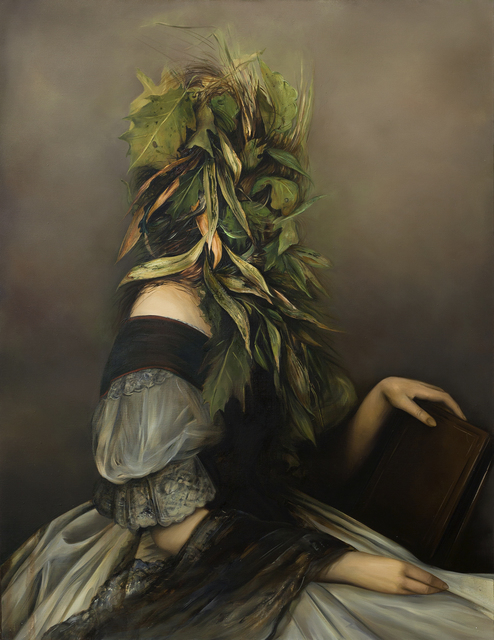
Juszkiewicz's paintings present a subtle disturbance with how she has altered these classic paintings. The end result is that of an eerie beauty, especially with women's portraits. She has been able to allow their natural elegant posture to come through, as well as make a rather noticeable alteration. I would like to create my own alterations of my ancestors by covering their faces, though because of my exploration of light and fabric so far, I am most likely going to use those as my mediums instead of painting.
Joachim Koester

"The Other Side of The Sky" exhibition
"Koester plays with the Art of storytelling through 16mm film, sound and photography, taking you on a journey to different times, places and states of consciousness. From hypnosis and hallucination to the psychedelic... Koester's experiential film makes the connection between Turner's seaward journey... internal journeys, and chemical ventures of the 1960's.
"Just strolling through the spaces might be enough for a visitor to get a sense of what is going on. I call this 'inhaling the show'- perceiving it through the body. There is also another conceptual landscape to be discovered"- Joachim Koester" - https://www.turnercontemporary.org/exhibitions/joachim-koester-the-other-side-of-the-sky
I visited the exhibition myself and found the films especially fascinating within the work on show. She also had an installation which I found inspirational; because of the wood she used it looked aged and seemed as though it carried a lot of memories. Also with it being life-size I felt this brings the viewer alot closer to the piece itself.
Her photography was something I was drawn to as well, because of the intricate shots she got of plants close up; this reminded me of my own work.
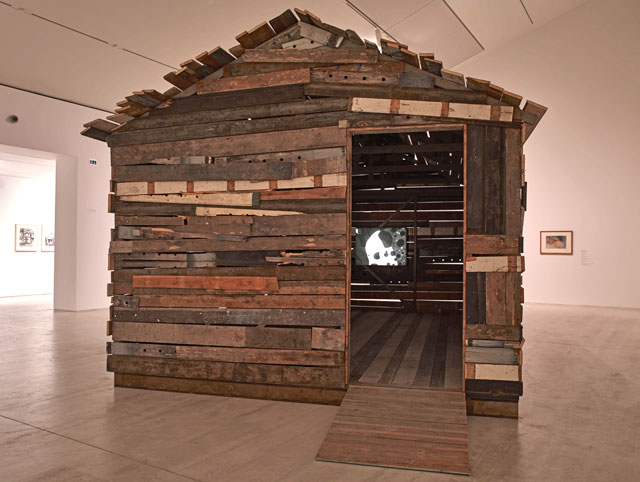

My own photography, which reminded me of Koester's work


Ewa Juszkiewicz
"She holds a painting degree from the Academy of Fine Arts in Krakow. She is a member of the VJ collective AAA Tanie Wizualki.
As an artist, she chiefly deals with the portraits of women. She creates paintings that refer to well-known early modern works, especially Flemish ones. The only difference lies in the way of presenting the portrayed persons' faces. Juszkiewicz imaginatively distorts these faces or substitutes them with large polypores, the bodies of insects, bouquets of flowers, tribal masks, or draped fabrics. Surrealistic, disturbing paintings loosely based on the originals are created as a result. These works by Juszkiewicz sometimes are copies with a single, subtle alteration."- http://culture.pl/en/artist/ewa-juszkiewicz
Juszkiewicz's paintings present a subtle disturbance with how she has altered these classic paintings. The end result is that of an eerie beauty, especially with women's portraits. She has been able to allow their natural elegant posture to come through, as well as make a rather noticeable alteration. I would like to create my own alterations of my ancestors by covering their faces, though because of my exploration of light and fabric so far, I am most likely going to use those as my mediums instead of painting.
Joachim Koester


Lael Marshall
"Initially working out her apartment, Marshall found that the domestic cleaning materials lying around started 'creeping into' her work. The result? Mixed media collages, many of which are on vacuum cleaner bags; dish towel paintings; and soap sculptures, including a series of soap cameras."-https://collabcubed.com/2012/02/01/lael-marshall-domestic-assemblages/
What really had me interested in Marshall's work was what I first saw of it; her fabric paintings.
She takes these materials she has found and makes them into beautifully subtle and fragile pieces of work. After seeing her paintings using these materials, I would really like to see how I can work with fabrics and materials in my own work.
"Hankie Painting" acrylic, casein on synthetic hankerchief
Oil and rabbit skin glue on cotton dishtowel
Yelena Popova
"With their transparent, softened geometric forms, Yelena Popova's paintings recall the graphics and aesthetics of both Russia Constructivism and Minimalism, and open up conversations about the materiality of painting today.
Popva's practice encompasses painting, video and installation, and all her work is tied together by an interest in exploring the concept of balance, whether on politics, representation, or in our relationship with machines."-http://www.saatchigallery.com/artists/yelena_popova.htm?section_name=new_art_from_russia
"Drying Time" by Yelena Popova
Anj Smith
"The eerie, luminous, compact portraits and landscapes of London-based artist Anj Smith are exercises in extravagant meticulousness. The magic of her laboriously depicted figures and motifs, however, derives in large part from the contrast Smith creates in surrounding areas of loamy, thickly applied impasto. This formal incongruence - between the intricate and the inchoate, between a jewel-like glow and rough scratchings, between filigree and mire - is crucial to Smith's work. It suggests that she seeks to navigate a murky psychological space far beyond the reach of her virtuosic single-bristle brush. In her world, certainty is just a vestige of the past, with everything today existing in a fragile, constantly shifting instability." - http://www.hauserwirth.com/exhibitions/1638/anj-smith-the-flowering-of-phantoms/view/

Emma Talbot
"In Emma Talbot's practice it is as much the mining of her own autobiography, as the biographies of others, both real, imaginary, and fictional, that is explored, sliced-open, edited and articulated. Micro memories and fantasies jostle on macro canvases. She negotiates the twentieth and twenty-first century struggle of the individual in life, in the family, at home, and in society through her work. The outcome is articulated directly onto canvas and paper, always with painter's brush and always freehand. The language of representation is developed into her own visual vocabulary, saturated with lived and unlived echoes, 1930's fonts, film, song, pop, literature, Japanese Shunga, Metaphysical poetry... Talbot takes where and what she needs and finds necessary - and makes it quite her own."-http://www.domobaal.com/artists/emma-talbot-bio.html
Because of how I have been looking at my dolls house, I really love the way Talbot reveals the interiors of scenes more than she does the exterior. Each scene she has created inside the rooms tell a story, although that may not be obvious at first glance. The way this work is executed requires the viewer to really focus visually in order to understand Talbot's pieces. Perhaps however, Talbot has no particular plot or story line to each room, and the images have been left for the viewer to interpret in their own way?
Madeline Von Foerster
"To create her paintings, Madeline uses a five-century old mixed technique of oil and egg tempera, developed by the Flemish Renaissance Masters. Although linked stylistically to the past, her paintings are passionately relevant to the present, as such timely themes as deforestation, endangered species, and war find expression in her work.
Meaning and beauty are the twin impulses expressed in the work, with neither sacrificed to the other. Concepts are developed and drafted in detail, often involving weeks of research and drawing for a single painting. Flora and Fauna, which appear in nearly every painting, are rendered with reverence and exactitude. Photographic references are always interpolated through the filter of the artistic process, being drawn via eye alone - never projected or traced - which adds to visual impression of timelessness.
In subject matter, however, the work is staked firmly to the present day. Humanity's relationship with Nature provides an impassioned narrative... sounding a recurring thematic knell. The ironic detachment of much contemporary art is challenged, in favour of intimacy, knowledge, and connection. The artworks could be described as "living" still-lifes, which intentionally use the motifs of that genre to explore our assumptions about ownership and objectification of Nature. But on a deeper level, they are visual alters for our imperilled natural world."
-http://www.madelinevonfoerster.com/news-statement.html

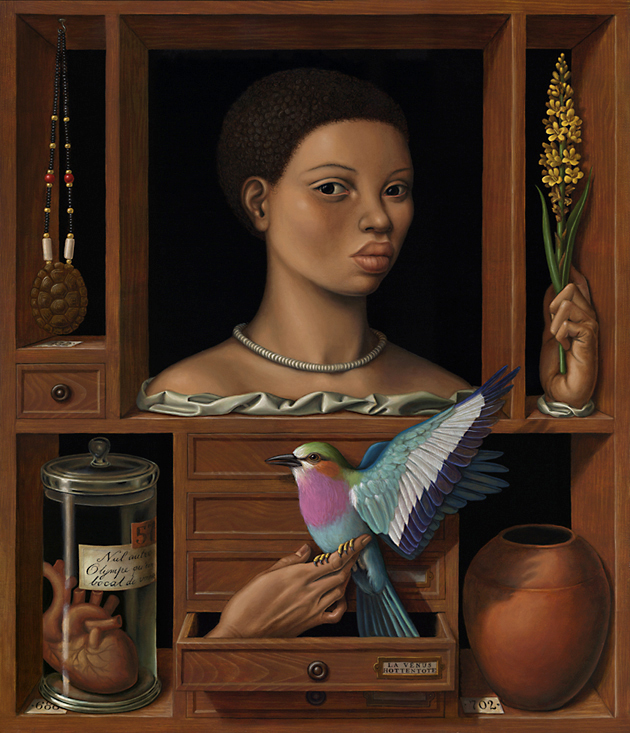
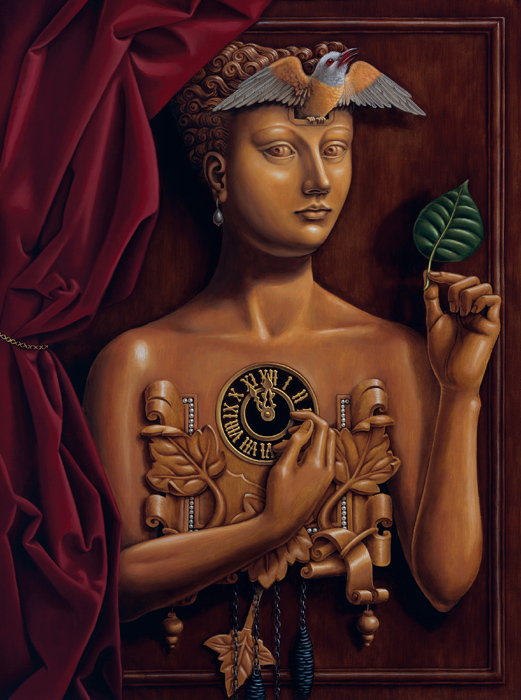



-http://www.madelinevonfoerster.com/news-statement.html
This work by Von Foerster uses beautifully dark and rich colours/shades which is something I would love to apply to my work in some sort of way. None of the colours used are very bright, which is probably the reason I am so attracted to her paintings. The way she moulds figures with furniture in these paintings I find fascinating! I may use something likes shelves in my work, but I'm not sure if I will make my ancestors into pieces of furniture!
Lisa Wright
"Lisa Wright's paintings and drawings are simultaneously rooted in the past and the present, intimately and emotionally entwined and historical portrait painting. Fragments of history - ribbons, ruffs, wigs and petticoats - are pieced together with a contemporary sensibility. The resulting figures hover between time periods. They also hover on the brink of adulthood: childish faces with rosy cheeks and rounded bellies at odds with their formal clothing and decorative adornments." - http://www.coatesandscarry.com/originals/lisa-wright
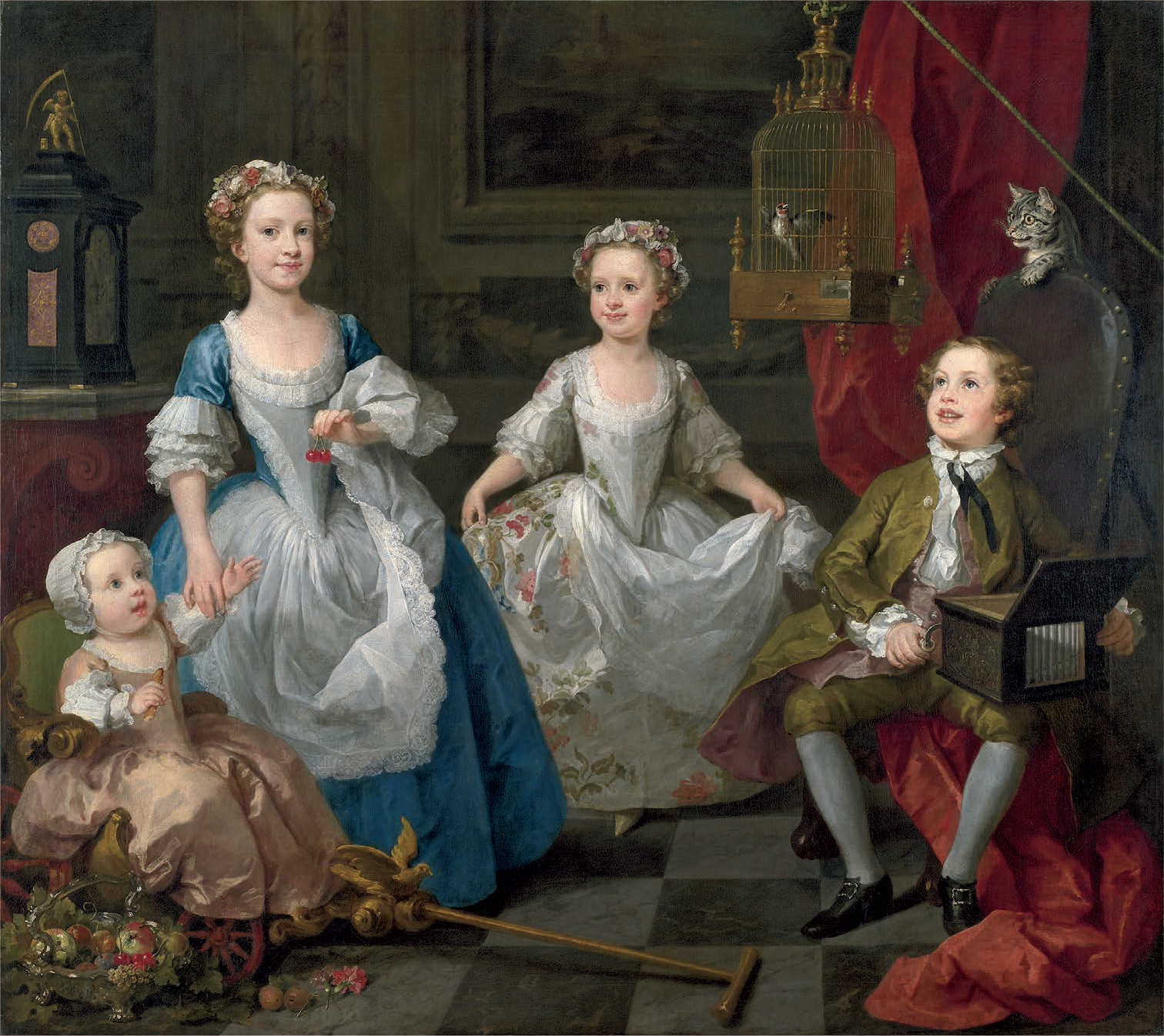
I have always been a fan of 18th Century paintings, and as soon as I observe Wright's work it immediately makes me think of paintings such as 'Clara' by Pietro Longhi, William Hogarth's "The Graham Children" and Marie Antoinette aged 12, painted by Martin Van Meytens.

No comments:
Post a Comment